
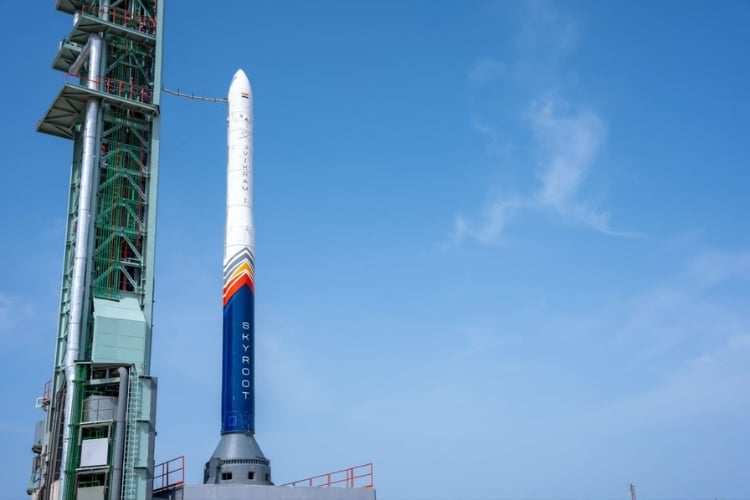
Skyroot Aerospace launched Vikram-1 from the Satish Dhawan Space Centre in Sriharikota on July 18, 2026, with the upper stage reaching its planned 450-kilometer low Earth orbit 15 minutes after liftoff. The mission, called Aagaman, made Skyroot the first Indian private company to place a rocket into orbit on its maiden attempt, putting India among a small group of nations alongside the United States and China with private orbital launch capability.
The flight carried two cubesats, one built by Skyroot and one by Indian startup Grahaa Space, plus hosted payloads from Dcubed and Cosmoserve Space, along with items including postcards signed by figures such as Prime Minister Narendra Modi. Modi called the Skyroot team after the launch to congratulate them. Speaking onstage afterward, CEO Pawan Kumar Chandana said he had "absolutely no words," calling it a historic moment not just for Skyroot but for India and the global space sector.
Vikram-1 is designed to place up to 350 kilograms into low Earth orbit, with an upgraded variant, Vikram-1U, expected to raise that to 550 kilograms. The mission targeted a 450-km orbit at a 60-degree inclination, and the launch is reported to have cost roughly $2 million to $3 million, with about 95% of the rocket's components built in India. Skyroot was founded in 2018 by former ISRO scientists Pawan Kumar Chandana and Naga Bharath Daka, and had previously flown the suborbital Vikram-S in 2022.