

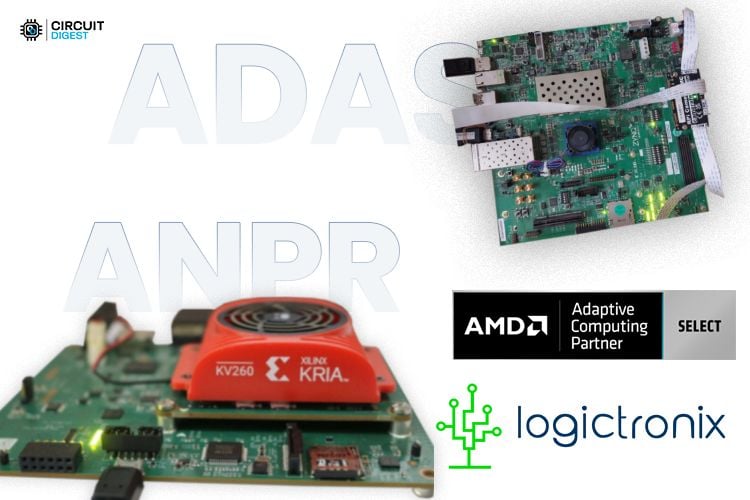
FPGAs have become a recurring subject in recent CircuitDigest features, appearing in themes of education and accessibility. In our interaction with Krishna Gaihre, CEO & Founder at LogicTronix, an "AMD-Xilinx’s Selected Partner (ACP) for FPGA Design and ML Acceleration," we explored the practical side of things. Before getting into anything about the company, it’s worth taking a step back to understand what FPGAs are and why they even matter for ML acceleration. FPGAs are reprogrammable chips, and ML acceleration is simply optimizing (reprogramming) hardware for specific models. Krishna views an FPGA as a ‘blank chip’ that can be programmed as requirements dictate.
Table of Contents
Why FPGAs?
When asked about how FPGAs compare to microprocessors for edge AI applications, Krishna explained how any choice really depends on performance needs:
CPUs: Great for general-purpose processing, but they are not really optimized for AI workloads.
GPUs: While excellent for AI and ML, they are often power-hungry and not cost-optimized for edge applications.
ASICs: Better than FPGAs from the standpoint of raw efficiency for a specific application. However, they are expensive to develop and fabricate, making them justifiable only for high-volume production.
FPGAs: Hit a lot of check boxes like low latency, high throughput, power optimization, and cost efficiency. Above all, they pack a special something called flexibility. Customers can change applications or machine learning models anytime, as nothing is set in stone.
Long story short, solutions requiring only a few frames per second can live with a regular CPU, while real-time custom solutions that need 30 FPS or more are up FPGAs’ alley.
Three Lanes
LogicTronix operates through three main areas:
IP Cores: The company has 29+ IP core offerings across segments, including computer vision, high-frequency trading, and cryptohashing.
Design Services: Beyond the IP cores, they develop turnkey vision-based solutions deployable on bare-metal, FreeRTOS, PetaLinux, or OpenAMP, supporting single- and multi-channel 2K/4K/8K video processing on Xilinx FPGA, MPSoC/SoC, and Versal platforms. Another key area is their Xilinx-based machine learning acceleration solutions.
Edge AI Solutions: The LogicTronix ANPR Solution (real-time vehicle license plate detection and recognition) works on the edge and packs cloud-compatibility for stuff like real-time analytics. What this simply does is recognize and record license plate data, which can help with applications like parking management and access control.

Their ADAS solution is capable of multi-sensor fusion and real-time machine-learning processing to assist drivers with functions such as object detection, lane tracking, parking aid, and collision warnings.
Recently, in December 2025, LogicTronix demonstrated its ADAS Sensor Fusion solution at an AMD Regional Technical Training (RTT) event in Kuala Lumpur, Malaysia. The tech is based on an AMD-Xilinx Versal adaptive SoC with vision and LiDAR among the sensors integrated.
The Flow
When a customer approaches LogicTronix with a requirement, what follows typically includes these steps:
- The Statement of Work (SOW) is defined
- The machine learning team creates or sources datasets, trains neural networks, and prepares models
- The FPGA team works in parallel on platform infrastructure, sensor integration, and output systems
- Models undergo quantization and compilation to make them FPGA-compatible
- Initial testing through evaluation kits
- Development of custom PCBs for final deployment
The Real World
Krishna gave us a couple of examples of how LogicTronix serves customers across industries:
Medical Industry
Multiple doctors having live feed access to surgeries is becoming increasingly popular for a number of reasons, including education and collaboration. To enable something like that, the company has worked on a surgical camera to which the client needed conferencing features added. FPGA was integrated to process the surgical camera output and combine multiple video feeds.
Automotive Industry
FPGAs are used to emulate sensors and other chips for early testing. The company has worked on an owner recognition feature, where the vehicle should be able to recognize the owner when at a certain proximity. This is something that requires low-latency, low-power vision and AI/ML processing deployed directly on the vehicle hardware.
Custom IP vs Off-the-Shelf
While there are plenty of generic IP cores available off-the-shelf and open source, Krishna noted the importance of custom IPs for critical use cases. While two IP providers can deliver the same functionality, parameters like performance and resource optimization, among others, will vary based on implementation. Typically, customers prefer working with a single vendor who can deliver a turnkey solution over integrating IP cores from multiple sources. The latter adds avoidable complexity to the testing and verification processes.
Customers are often hesitant to rely on open-source IP cores due to the risk of encountering an issue later and not having any support then. The bottom line is that open-source platforms like OpenCores offer trusted and verified IP cores and make absolute sense for prototyping and early-stage development; however, verified IP cores accompanied by vendor support and quality assurance are what production-ready solutions demand.
A Decade of Reprogramming
Reflecting on his experience, Krishna said, “I personally started on FPGA since 2012, 2013, like that. So at that time, mostly pure FPGA device are more popular, and the application would be mostly like video-based applications, sometimes like glue-logic-based applications; connecting different platforms and systems, like that.” This was followed by the market seeing a good number of heterogeneous devices like SoCs and PSoCs (Programmable System-on-Chips). Over the past decade, FPGAs have evolved from handling simple glue-logic tasks to complex applications across domains, including 5G and 6G communications, automotive sensor processing, where working with LIDAR and RADAR data quickly is critical, and advanced video systems. Today, with all the evolved capabilities, FPGAs are particularly relevant for edge AI, where adaptability, low latency, and domain-specific acceleration matter way more than they used to.