
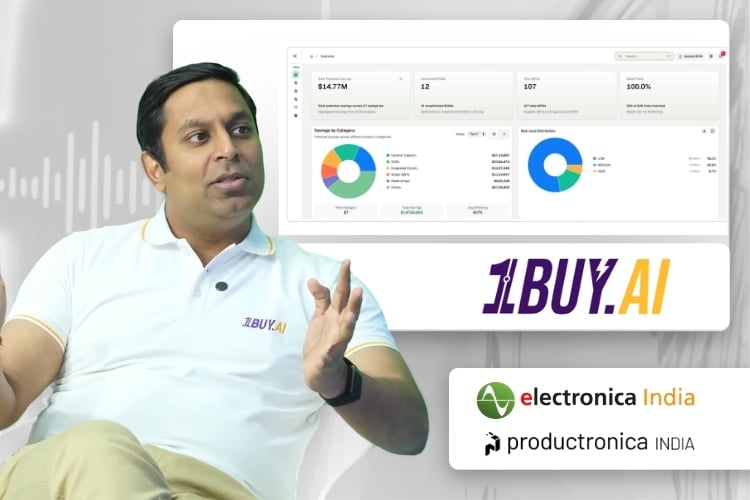
At electronica India 2026, Nitin Jain, co-founder of 1Buy.AI, sat down with Aswinth Raj, editor of CircuitDigest, for an episode of electronica Xchange to discuss the role of artificial intelligence in procurement and its impact on India's supply chain. Nitin called electronica "a vibrant event," saying the first day had been strong and he expected even more inbound interest at the company's booth on the second day.
Background
Nitin described himself as an IIT Delhi computer science engineer who built two companies between 2015 and 2025 in supply chain and financing, both working with small and medium enterprises. He said that experience gave him direct knowledge of the problems faced by purchasers, business owners and suppliers. Nitin said the team at 1Buy.AI set out to combine that industry knowledge with emerging technology to build what he called the best procurement platform for global companies, aiming to be "the world's best electronic components supply chain platform" driven entirely by AI.
The Problem 1Buy.AI Set Out to Solve
Nitin said a typical company uses 5,000 to 10,000 components, ranging from capacitors and resistors to MOSFETs, and that it is "physically or mentally impossible" for a human to optimize across that many parts. He described the electronics component market as a $150 billion industry in India and a $2.3 trillion industry globally, with roughly a billion SKUs in circulation. He contrasted it with more concentrated industries like steel, saying electronics sourcing involves a large, fragmented base of manufacturers and distributors, which he called "the most complex and scattered industry."
How the Platform Works
Nitin said 1Buy.AI built AI agents that integrate with a company's ERP system, study every component in a bill of materials, and cross-reference it against live market data. The agents then provide a detailed breakdown for each part, including current purchase price, weighted average market price, lowest available market price, and which distributors are offering better rates. From there, he said, the agents carry out supplier negotiations directly. Nitin said clients have seen bill-of-materials costs fall by five to 15 percent on average.
He walked through what happens when a procurement engineer uploads a 5,000-SKU bill of materials to the platform: the AI agents analyze pricing, quantities and suppliers against market data, then flag the top 50 components that should be renegotiated immediately. For those components, the system recommends whether to renegotiate with the existing supplier or switch, while also surfacing supply chain, lifecycle and compliance risks, and identifying parts that are end-of-life or not recommended for new designs. Nitin said the platform can then execute negotiations with suppliers at the click of a button. He noted that 1Buy.AI positions itself as a platform rather than a trader or distributor.
Data Infrastructure
Nitin said the AI models run on proprietary data drawn from an estimated 400 to 500 data pipes, combining distributor APIs, partnered companies that supply data, purchased trade data, and AI agents that scrape real-time market data from the internet. He said all of this is consolidated into a single monthly view for clients.
Business Model
Nitin outlined three platforms under 1Buy.AI. The first is a data platform, which analyzes a client's bill of materials and operates on a subscription model charged per component per year. The second is a sourcing platform, where 1Buy.AI is mandated to source components on a client's behalf and is paid a percentage of the savings generated. The third is a liquidation platform, where multiple vendors sell excess inventory and 1Buy.AI charges a percentage of the resulting sales.
Traction and Results
Nitin said 1Buy.AI has onboarded close to 200 suppliers and works with about 50 companies in India and globally. He said the company has analyzed an average of about 2,000 components per client and saved companies an average of five to seven million dollars each. Reflecting on adoption, Nitin said that in his 10 to 12 years in the supply chain industry, he had "not seen this kind of fashion," adding that customer demand has outpaced the company's current bandwidth, forcing it to turn some prospective clients away.
Expansion and Outlook
Nitin said 1Buy.AI has raised funding from prominent investors and is expanding teams into China, Taiwan, Korea, Hong Kong and Europe to strengthen its supply chain reach. He said interest in the platform has been roughly equal across geographies rather than concentrated in India. Looking ahead, Nitin said AI would transform the electronics supply chain industry by allowing procurement managers to multiply their capacity rather than requiring companies to add large teams to manage thousands of components. He said the company's next milestone is to close the year at $100 million in revenue, which he described as on pace to be "the fastest start," though he declined to share current revenue figures.

Add a comment
No account needed. Your comment appears once a moderator has reviewed it.